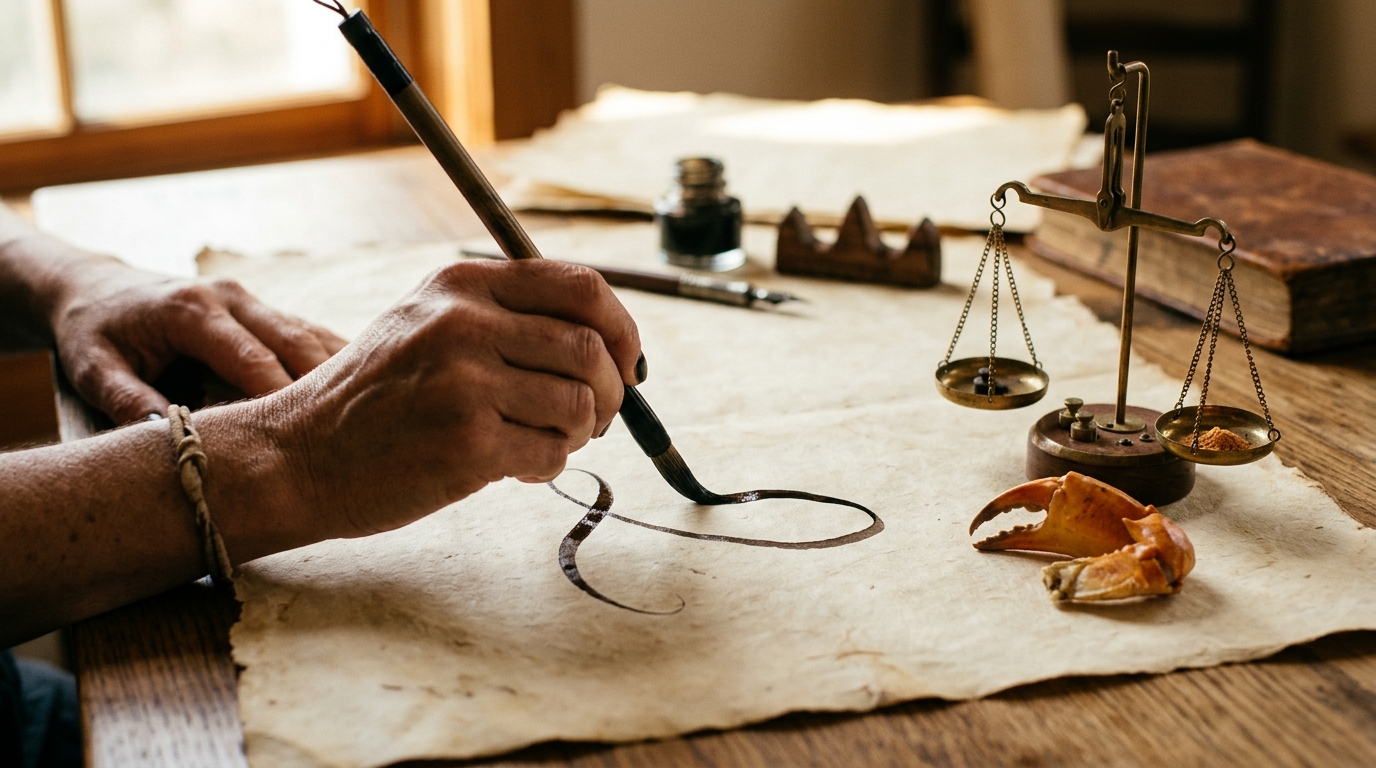
Cancer's glyph looks like a 69 lying on its side, and almost nobody who wears it on a necklace can say why. It isn't a crab, and it isn't a number. Like the other eleven, it is a scribe's shorthand that got smoothed out over centuries until the picture was mostly gone.
Quick table: all 12 glyphs and what they depict
The answer to "what are the 12 symbols of the zodiac?" is two lists: the creature or object each sign is named for, and the glyph, the small drawing that stands in for it. The table gives both, plus what the drawing shows. The depictions are our reading; for several, the derivation is traditional and not documented.
| Sign | Glyph | Creature or object | What the drawing depicts |
|---|---|---|---|
| Aries | ♈ | Ram | Two curling horns joined at a stem |
| Taurus | ♉ | Bull | A round head with a crescent of horns |
| Gemini | ♊ | Twins | Two figures joined by a top and bottom bar (Roman numeral II) |
| Cancer | ♋ | Crab | Two claws curling around two small circles, giving the sideways 69 |
| Leo | ♌ | Lion | A looped mane flowing into a curled tail |
| Virgo | ♍ | Maiden | A looped letter M with a crossed tail |
| Libra | ♎ | Scales | A horizon line under a sun setting, or a beam balance |
| Scorpio | ♏ | Scorpion | A letter M ending in an arrow |
| Sagittarius | ♐ | Archer | An arrow crossed by a short bar |
| Capricorn | ♑ | Sea-goat | A V-shaped goat's body trailing into a fish's looped tail |
| Aquarius | ♒ | Water-bearer | Two parallel wavy lines of water |
| Pisces | ♓ | Fishes | Two arcs facing away from each other, tied by a bar |
Where did the glyphs come from?
The Wikipedia entry on astrological symbols says they originate in medieval Byzantine codices and Greek papyri before taking modern forms. That is as firm as the story gets. Scribes copying horoscope texts needed a fast way to write a sign or planet in a margin or a table, so they abbreviated. Some marks may be contractions of Greek words, others reduced pictures. Which is which is often unclear, and anyone who gives you a single confident origin for every glyph is smoothing over a patchy record.
The creatures are older than the glyphs. The Yale medical astrology exhibit notes that the word zodiac, or der Tierkreis in German, means a circle of animals. For where that circle came from, see the Babylonian origins of the 12 signs. The glyphs are a later layer, a handwriting habit applied to an existing set of images.
So why Cancer's 69? Two claws, or possibly the crab's eyes or a pair of breasts or a flow of two streams, depending on who you ask. The claw reading is the most common, and the form is a pair of curls with a dot at each head. Treat it as the standard reading, not a proven one. The shapes also changed by hand and by printer; type designers fixed the versions most people see today.
Here are the ones with the most solid footing. Aries and Taurus read easily as horns. Gemini resembles the numeral II, which fits twins. Aquarius is water, drawn twice. Pisces is two fish with a cord between them. Those are pictures you can check with your own eyes.
The confusing ones: Virgo, Scorpio and Capricorn
Virgo and Scorpio look nearly identical at first glance. Both have an M-like set of humps. The difference is the tail. Scorpio's ends in an arrow, which fits a stinger. Virgo's tail loops back and crosses itself. One long-standing reading takes Virgo's loop as a maiden's folded wheat sheaf or closed womb; another takes the M as an abbreviation of the Greek word for virgin, parthenos, though that word begins with a pi, not an M. Treat both as traditional guesses. The arrow on Scorpio is easier to defend, and some writers think Scorpio's M-shape is the older shared form of both.
Capricorn is the hardest to see as an animal. The creature is a sea-goat, a goat in front and a fish behind. In the glyph, the V-shaped stroke stands for the goat's head and horn, and the looping tail is the fish. It is the most compressed of the twelve. Two creatures were squeezed into a single pen stroke, so the picture is mostly gone and only the join remains.
Libra is the odd one out because it is an object, not a creature, and the glyph doesn't settle which. Some read a beam balance. Others read a sun sinking toward a horizon line, which suits a sign tied to the autumn equinox. Both readings circulate, and neither is proven.
What does your glyph say about your sign's mechanism?
"What does each zodiac sign symbolize?" has a layered answer. The creature supplies imagery. The mechanism supplies the logic, and it comes from the sign's element, modality and ruling planet. Modality means whether a sign opens a season (cardinal), holds its middle (fixed) or closes it (mutable). The ruling planet is the traditional planet assigned to each sign.
Some links hold up well enough to point at. Aries is cardinal fire ruled by Mars, and its horns are a forward-pushing, head-first image. Taurus is fixed earth ruled by Venus, and a bull standing its ground is a fixed-sign picture. Gemini is mutable air ruled by Mercury, and a pair of twins joined by bars suits a sign about exchange. Cancer is cardinal water ruled by the Moon, and a claw that curls around what it holds fits water that protects.
Now the caution. These matches are traditional and interpretive. Nobody derived Leo's mane from fixed fire; the lion and the element were paired in a long tradition, and the glyph was drawn afterward. Libra being cardinal air ruled by Venus, and Aquarius being fixed air, are placements that stand on their own and not outcomes of the drawings. Where a glyph seems to "explain" a sign, it is usually the reverse: we read the shape through what we already know.
For the full set of elements and dates, see the 12 signs, their dates and their elements. The Chinese system uses animals too, but a different logic, covered in Chinese vs. Western zodiac. The myths behind several creatures are in the Greek stories hiding in your sign.
Frequently asked questions
What are the 12 zodiac symbols?
Ram, bull, twins, crab, lion, maiden, scales, scorpion, archer, sea-goat, water-bearer and fishes, for Aries through Pisces. Each also has a glyph, a short hand-drawn mark that stands in for the creature or object in charts and tables.
What does each zodiac sign symbolize?
Each sign's creature or object supplies its imagery, and its element, modality and ruling planet supply its logic. The pairings are traditional and interpretive, not derived from the drawings. The table above shows what each glyph depicts.
How many symbols are in the zodiac?
There are twelve, one per sign. If you count both the creature and the glyph, that gives two forms per sign. Planets, nodes and aspects have their own separate glyphs, so a full chart uses many more marks than twelve.