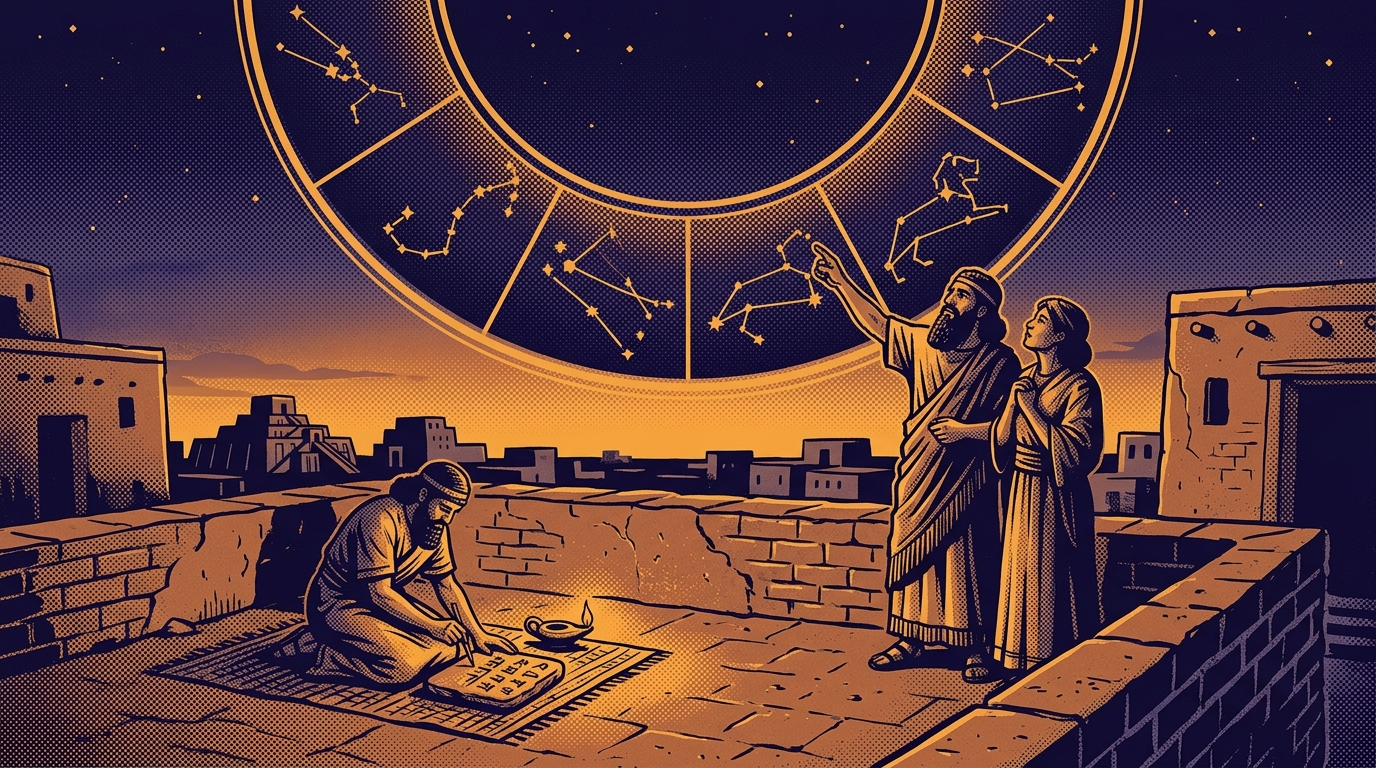
Why did the Babylonians need 12 equal signs?
Nobody in ancient Mesopotamia sat down to design a personality system. The zodiac began as a ruler. Babylonian scribes had a practical problem: the Moon, the planets and the Sun all travel along the same narrow band of sky, and they needed a way to say where along that band something was. Without a fixed scale, "Jupiter is near the Lion's heart" is about as precise as you can get.
The answer was to cut the band into equal pieces and number the degrees. The zodiac and its 360-degree measurement originated in Babylonian astronomy during the 1st millennium BC, and that is the part scholars agree on. The exact decade of the cut is less settled, and pages that give a single confident year for it are guessing. This article uses c. 500 BCE as the working date and flags where the evidence is thinner.
Astrologers rarely say this out loud, but it matters for everything below. The 12 signs are a coordinate system first and a set of characters second. The characters came later, and mostly from other people.
MUL.APIN and the 18 constellations that came before the zodiac
Before the zodiac there was MUL.APIN, a Babylonian compendium of star lore written on two cuneiform tablets. Its core is usually dated to around the turn of the first millennium BCE, though the surviving copies are later. It lists constellations along the paths of the Moon and planets, and scholars commonly count about 18 of them in the band that later became the zodiac. Counts vary with how you treat paired or borrowed figures.
These were not 12 tidy slices. They were uneven star patterns of very different widths. Some names will be familiar: the Bull of Heaven, the Great Twins, the Crab, the Lion, the Scorpion, the Goat-Fish. Others have no modern sign attached, like the Hired Man, who sits roughly where Aries does, or the Furrow, who is tied to Virgo's bright star Spica. MUL.APIN is a catalogue of landmarks, not a framework.
That difference is the whole story. Uneven landmarks are fine for finding a star. They are useless if you want to calculate where the Moon will be in 19 days.
Around 500 BCE: the 30° cut and the 360-day schematic year
Babylonian calendar-keepers worked with a lunar year of 12 months. For arithmetic, they used a schematic year of 12 months of 30 days, or 360 days. That is not the real length of a year (about 365.25 days), and the scribes knew it. It was a tidy model for calculating, the way a modern spreadsheet might assume 30-day months.
The 360-day model pairs neatly with a circle of 360 parts. Divide the ecliptic, the Sun's apparent yearly path, by 12 and you get 12 slices of exactly 30°. Babylonian mathematics was sexagesimal, counting in sixties, and 360 divides cleanly by 2, 3, 4, 5, 6, 8, 9, 10, 12 and more. The Sun moves roughly one degree a day, so a degree stands in for a day of the schematic year. The scheme's convenience is the likely reason it won, though the surviving texts don't record anyone stating that.
The earliest evidence of the finished scheme is thin and scattered. Astronomical texts using the 30° signs appear in the fifth century BCE, and the oldest known horoscopes cast for individual births in cuneiform date to around 410 BCE. Even then, scribes disagreed about where to start the count. Two later computing systems of Babylonian astronomy, called System A and System B, put the start of Aries at different spots, around 8° and 10° of the sign in the modern sense. That is early evidence that the sign boundaries were a convention, and conventions get argued about.
The 12 slices, in order, each 30° wide:
- Aries: 0°–30°
- Taurus: 30°–60°
- Gemini: 60°–90°
- Cancer: 90°–120°
- Leo: 120°–150°
- Virgo: 150°–180°
- Libra: 180°–210°
- Scorpio: 210°–240°
- Sagittarius: 240°–270°
- Capricorn: 270°–300°
- Aquarius: 300°–330°
- Pisces: 330°–360°
This is the answer to "what are the original 12 signs." Every name was borrowed from the constellations that happened to sit nearest each slice. Babylon supplied the slices. The images came from the sky.
There was a reason to watch the sky so closely. Mesopotamian priests used the stars for state omens, so exact positions mattered to the people paying for the observations. Omens about the king and the harvest are not personality readings, though. That step came from somewhere else.
How did the Greeks turn star markers into personalities?
Alexander the Great took Babylon in 331 BCE, and over the next few generations Babylonian astronomical methods and Greek philosophy ended up in the same cities, notably Alexandria. The Greeks had geometry, a developed theory of the elements, and a deep store of myth. They also had a habit of asking why. A Babylonian text could say "Mars enters the Scorpion and a bad omen follows." A Greek writer wanted a cause for it.
The result is Hellenistic astrology, written mostly in Greek between roughly the second century BCE and the third century CE. It added the concept of the horoscope as the rising point at birth and the system of houses. It also turned the 12 slices into 12 distinct characters. The Greeks named the 12 signs, with Aries and Pisces among them, and the Greek names are what almost every modern language still uses in translation.
Note what this means for the claim you may have read on other sites that Babylonians attached myths to the signs. The Babylonian constellations had their own lore, such as the Bull of Heaven in the Gilgamesh tradition. The 12-sign myths we know, a golden ram or a Nemean lion, are Greek, and several are later still.
Ptolemy's Tetrabiblos and the elements, modalities and rulerships
The most influential single text is the Tetrabiblos of Claudius Ptolemy, written in Alexandria around 150 CE. It did not invent everything in it. It gathered and tidied existing practice into one coherent argument, and that coherence is why it survived. Ptolemy anchored the signs to the seasons: Aries begins at the spring equinox, which is the tropical choice discussed in the next section. He also gave a reasoned account of the elements, the modalities and the planetary rulerships.
Here is the mechanism most guides skip. The 4×3 grid is not a coincidence. It falls out of dividing the circle into 12.
Elements. Going around the wheel, every fourth sign shares an element. Aries, Leo and Sagittarius are 120° apart, forming a triangle, and the same goes for the other three triangles. Four triangles give four elements: fire, earth, air and water. The idea of four elements comes from Greek natural philosophy. The pairing of each triangle with its element is traditional, and ancient authors justified it with qualities like hot, cold, wet and dry rather than with any measurement.
Modalities. A modality is the quality of a sign's job within its season. Every third sign shares one, making squares at 90° to each other. The four points where the year turns, the two equinoxes and two solstices, mark the start of Aries, Cancer, Libra and Capricorn. Those are cardinal signs, the ones that begin a season. The middle sign of each season is fixed, and the last is mutable, where the season changes over. Ptolemy's own terms were "tropical," "solid" and "bicorporeal," which later became cardinal, fixed and mutable.
Because 3 and 4 share no common factor, each element pairs with each modality exactly once. That gives 12 unique combinations, so no two signs are the same recipe. Cardinal fire is Aries, fixed fire is Leo, mutable fire is Sagittarius, and so on around. It's a neat bit of structure, and it exists because 12 happens to be 4 × 3.
Rulerships follow a similar logic. The ancients knew seven bright wandering bodies: the Sun, Moon, Mercury, Venus, Mars, Jupiter and Saturn. The Sun and Moon took Leo and Cancer, and the five planets took two signs each, one on either side. The assignments are traditional and were justified by the planets' qualities and distance from the Sun, not derived from anything you could measure.
Myths attached to the signs, from Aries' golden ram to Scorpio's sting
The myths were laid on afterward, and they vary by source. Here are some of the standard pairings. None of these tells you what a sign is like; they are traditional stories, and astrologers treat them as symbolic color.
- Aries: the golden ram that carried Phrixus and Helle away from danger, whose fleece Jason later sought.
- Taurus: often linked to Zeus disguised as a white bull who carried off Europa.
- Gemini: the twins Castor and Pollux, the Dioscuri.
- Cancer: the crab sent by Hera that pinched Heracles during his fight with the Hydra and was crushed.
- Leo: the Nemean lion, whose hide Heracles wore.
- Scorpio: the scorpion sent to sting the hunter Orion, which is why the two constellations are never in the sky together.
- Pisces: commonly linked to Aphrodite and Eros turning into fish to escape the monster Typhon.
Several signs have more than one competing story, and Virgo and Capricorn in particular are claimed by different myths in different sources. For the full catalogue, see the Greek myths hiding inside each sign.
When did the signs and the constellations split apart?
The short answer is that they were never the same thing, and they have been drifting for about 2,000 years. This is the section where precision matters, so a plain statement first: astrology is a symbolic system, not astronomy. The signs are 30° divisions of a measuring scheme. The constellations are irregular star patterns in the sky. This section is about why the two stopped lining up, and the lesson is not that astrology is broken but that it was never claiming to be a map of the constellations.
The constellations themselves have very different widths. Virgo takes up far more of the ecliptic than Scorpius does, which is part of why the Babylonian star list was unsuited to calculation. A 30° slice is a slice. It has no obligation to match the stars behind it.
Hipparchus, precession and the tropical choice
The Greek astronomer Hipparchus, working in the second century BCE, is generally credited with detecting precession. Earth's axis wobbles slowly like a spinning top, taking about 25,800 years to complete one cycle. As a result, the points where the Sun crosses the celestial equator, the equinoxes, creep westward against the background stars at roughly 1° every 72 years. Hipparchus estimated a slower rate, at least a degree per century, but he found the effect.
That creates a choice. You can anchor the signs to the stars or to the seasons. The tropical zodiac, from the Greek word for "turning," anchors them to the seasons: 0° Aries is wherever the Sun is at the March equinox, whatever stars are behind it. The sidereal zodiac, from the Latin for "star," anchors them to the fixed stars.
Ptolemy, working in the Hellenistic tradition, chose the tropical. That is the one most Western astrologers and nearly every app use today. When the system was formalized, the two nearly matched, so it didn't matter much. Today the gap is about 24°, and it grows by about a degree every 72 years.
The sidereal holdouts in India
Indian astrology, known as Jyotish, absorbed Hellenistic ideas in the early centuries CE but kept the star-anchored version. The offset between the two zodiacs is called the ayanamsa, and for the commonly used Lahiri version it is a bit over 24° in the 2020s. Different Indian schools use slightly different values, so even within the sidereal tradition the boundaries are not identical.
The practical effect is that many people have a different Sun sign in the sidereal system, usually the one before their Western sign. Sources disagree about cusp dates for exactly this reason, as well as because of the yearly ingress shift described below. The sidereal-versus-tropical argument is covered in detail in this piece on your Vedic sign. Neither approach is more correct astronomically. They are two answers to the question "what should the signs be pinned to?"
Where do the glyphs ♈ to ♓ come from?
The glyphs are the youngest part of the system. Babylonian tablets did not use them, and neither did Ptolemy. They developed in Greek and Byzantine manuscripts as scribal shorthand, then were standardized by medieval copyists and, later, by printers. Even today, scholars disagree on the origin of several of them, so treat the following as the most commonly proposed readings, not proven ones.
Some are close to pictures:
- Aries ♈: a ram's horns, or a sprouting plant, depending on who you ask.
- Taurus ♉: a bull's head and horns.
- Gemini ♊: two upright strokes joined by bars, usually read as the twins standing together, or a Roman numeral II.
- Sagittarius ♐: an arrow with a crossbar.
- Capricorn ♑: a goat's body with a fish's tail, simplified through repeated copying.
- Aquarius ♒: two wavy lines for water.
- Pisces ♓: two fish joined by a cord, matching the myth of the fish tied together.
Others are less obvious and more disputed. Cancer ♋, the famous "69," is said to depict crab claws, though some have read it as a different image entirely. Leo ♌ may be a lion's mane and tail, or a stylized Greek letter. Libra ♎ is generally taken as the scales, or as the Sun setting on the horizon. Scorpio ♏ is an M-shaped form with a stinger, and Virgo ♍ is an M with a curl.
These last two are common questions. On a Reddit thread on glyph origins, people ask where the arrow for Sagittarius or the curled "M" for Virgo came from. Readers report being puzzled by exactly these shapes, and there's no single settled answer. A popular but unproven theory says some glyphs derive from abbreviated Greek words, for instance the first letters of a sign's Greek name, but the evidence is patchy.
The takeaway: the pictures are late and the forms have wobbled for centuries. For a closer look at each symbol, see what the 12 glyphs encode.
How did the zodiac become a calendar?
The zodiac became a calendar through a simple observation. If the Sun moves about 1° a day through 30° slices, then it spends about a month in each sign. The schematic Babylonian year of 12 × 30 days made that exact. The real year doesn't, because the Sun covers 360° in about 365.25 days, so the average stay in a sign is about 30.4 days.
It is not even constant. Earth's orbit is slightly elliptical, so the Sun appears to move faster across the sky in northern winter and slower in summer. The Sun spends roughly 29 days in a winter sign like Capricorn and nearly 32 in a summer sign like Gemini. This is one reason sign dates printed in different places are never identical.
The Greeks made the calendar anchor seasonal. In the tropical system, the four cardinal signs begin at the four turning points of the year: Aries at the March equinox, Cancer at the June solstice, Libra at the September equinox, and Capricorn at the December solstice. The time the Sun crosses into a sign is called its ingress, a word you'll see in astrological forecasts. Ingresses are moments, not dates, and they are given in a specific time zone. In 2026 the March equinox falls about 14:46 UTC on 20 March, so someone born earlier that day in London or Los Angeles is a Pisces and someone born later that day is an Aries.
This is the real reason cusp dates vary. Three things stack up:
- The ingress moment shifts by several hours from year to year, because the calendar year and the solar year don't match, and leap years pull it back.
- The ingress is a precise time, so your birth time and birth place can change your sign on the boundary day.
- Some sources use the sidereal zodiac, which moves every boundary by about 24°.
Sources that print "Aries: March 21 to April 19" are rounding. If you were born within a day of a boundary, the birth year and birth time are what settle your sign.
The zodiac as a calendar also goes back further than its signs. The Egyptians had their own sky-based calendar tied to the star Sirius, as a history of horoscopes mentions, and Egyptian astronomy contributed its own divisions of the sky. The zodiac we have is the Babylonian-Greek line, but it was not the only sky calendar in the ancient world.
So what does 2,500 years of history change about your sign?
Start with the question people actually ask: is there any truth to zodiac signs? The history gives a precise answer. The signs are real in the way a latitude line is real. They are a defined, reproducible convention for dividing the Sun's path, and your Sun sign is a fact about which slice the Sun was in when you were born. What astrology claims that slice means for a person is a separate, symbolic claim. It rests on tradition and interpretation, not on a measured mechanism, and astrology as a symbolic system does not stand or fall on whether Aries stars look like a ram.
The history also takes the air out of several common arguments.
"The constellations moved, so your sign is wrong." This confuses the signs with the constellations. The tropical signs were never meant to line up with the stars behind them. They track the seasons. The sidereal version does track the stars, and it's a legitimate alternative, not a correction.
"Ophiuchus is the thirteenth sign." The Sun does cross the edge of the Ophiuchus constellation. But the zodiac was built as 12 equal slices because 12 slices of 30° fit a 360-day schematic year. The constellation boundaries came later and don't change the measurement scheme.
"Your personality is in the myth." The myths were attached by Greeks centuries after the slices were cut. Treat them as folklore, which is a fine way to remember a sign but not where the sign's meaning comes from. The structure that does have a mechanism is the 4×3 grid of elements and modalities. That is where your sign's character in a chart has a stated logic: a fixed earth sign and a mutable earth sign share an element but behave differently because of their position in the season.
It also explains why the Sun sign is only part of the picture. A sign is a 30° piece of a measuring wheel, and the Sun is one of ten bodies on it. If you want to see where the rest of your chart's planets land, see where your own sign falls in the 12-sign system.
Finally, the history gives you a way to read arguments about the zodiac. If someone says the Babylonians gave Scorpio a nasty personality, you know they didn't. If someone gives you a single date for the cusp, you know it hides a time zone. And if someone says the zodiac is "just made up," you can answer that it was made, deliberately, as a ruler, and then given a personality by people who loved a good story.
For a comparison with another sky-based system, see how the Chinese zodiac differs.