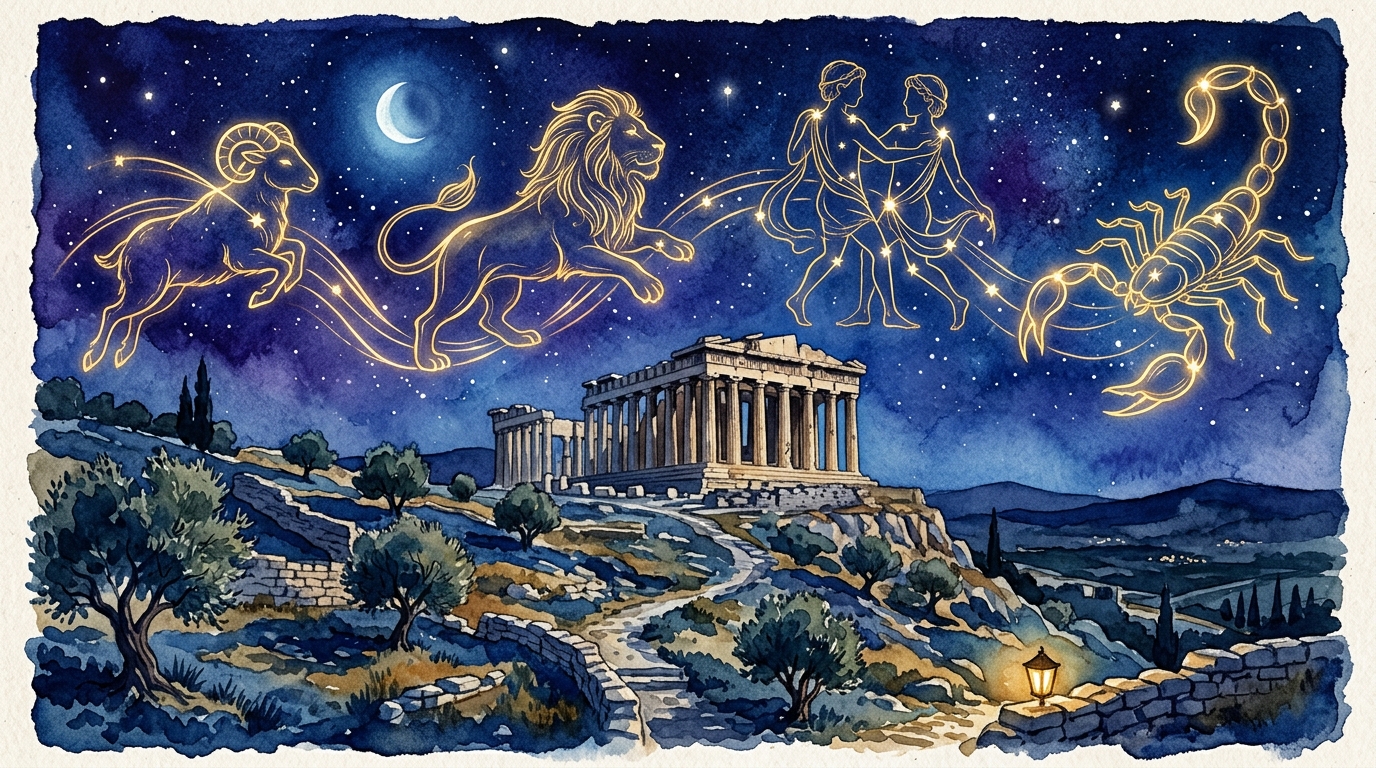
Aries: the golden ram of Phrixus
Orion was reportedly killed by a scorpion, and Leo's lion couldn't be hurt by any weapon until Heracles used his hands. The twelve sign myths are stranger and more specific than the adjective lists you've seen, and they line up with the elements and modalities in ways worth testing. Be warned that the pairings below are my reading, not something the Greeks wrote down. The constellations also predate the Greek stories: the Babylonians were the first to apply myths to constellations and describe the twelve signs, and the Greeks layered their own stories on top.
In the Greek version, Crius Chrysomallus, the golden ram sent via Poseidon and Theophane, rescued Phrixus and Helle. The children were facing sacrifice under a scheming stepmother. The ram carried them off over the sea. Helle fell and drowned in the strait later called the Hellespont, while Phrixus arrived safely and sacrificed the ram. Its fleece became the Golden Fleece Jason later chased.
Here is the pairing. Aries is cardinal fire. Modality means how a sign operates within its element: cardinal signs start things, fixed signs sustain them, mutable signs adapt and finish them. The ram's story is all ignition. A crisis, a leap, no committee. Fire supplies the urgency, and the cardinal quality supplies the first move. Notice the cost, though: the rescue is only half successful. Helle doesn't make it. That is a fair note on cardinal fire, which starts fast and doesn't always check who kept up.
Leo: the Nemean lion
The Nemean lion had skin that no weapon could pierce. Heracles, on his first labor, found arrows and club useless and strangled it with his bare hands. He then skinned it using the lion's own claws, since nothing else would cut the hide, and wore the pelt. Hera or Selene is named as the lion's mother or sender in different tellings, and some versions have it fall from the moon. Ancient sources vary, so treat any single origin as one variant.
This is fixed fire. Fixed signs hold their ground, and Leo's lion is defined by what it refuses to yield: invulnerable, territorial, unmoved by arrows. Fire gives it the visible heat and the fixed modality gives it the staying power. The myth is also useful for what it doesn't say. It makes the lion a nearly unbeatable opponent, not a flattering ruler. The "Leo is the king" idea comes more from the Sun ruling the sign than from this story. That's a separate tradition: the Sun as Leo's ruler is derived from planetary rulership, while the lion myth is borrowed from the hero's labors.
The lion is dealt with by closeness, not distance. Heracles has to grapple. Fixed fire at its best is a presence you have to deal with directly.
Scorpio: the scorpion sent to kill Orion
Orion the hunter was a famous giant, and the story of his death has several versions. In one, he boasted he would kill every animal on earth, and Gaia sent a scorpion. In another, Artemis sent it because Orion had offended her. In a third, Hera is the sender. Still another has Apollo trick Artemis into shooting him. These are variants, and none is the single correct one. Most agree that the scorpion stung him, and the two were set in the sky on opposite sides, so that Orion sets as Scorpius rises.
I read this as fixed water. Water is feeling, depth and what stays under the surface. Fixed means it holds. The scorpion doesn't chase; it waits, and one sting does the work. The ambush is patient, and the grudge is the whole point of the animal's role in the story. That's the reading, not ancient doctrine. The myth also leaves out a detail that Scorpio lists love: nothing in it says the scorpion was jealous or secretive. It carried out a task for a god.
Scorpio's traditional ruler was Mars, with Pluto added in modern astrology. A sting is a Mars-style act, which fits the older rulership better than the newer one.
Gemini: Castor and Pollux
Castor and Pollux, called the Dioscuri, were twin brothers with different fathers in most tellings. Castor was mortal, the son of Tyndareus, and Pollux (Polydeuces) was divine, the son of Zeus. When Castor was killed, Pollux asked Zeus to share his immortality, and the brothers alternated between the underworld and the sky. A reader on Reddit puts it simply: Gemini is the Dioscuri twins Polydeuces and Castor, which is what people report, and it matches the usual account.
Gemini is mutable air. Mutable signs adapt and carry a season toward the next one, and air is about exchange and ideas. The twins are a movement between two states, mortal and divine, below and above. That is the mutable part. Air fits the pairing, because the story is about a relationship and a negotiation. Again, this is our reading. If you want to see why Gemini takes the blame in online polls, mutable air explains the "fakest sign" reputation, and why that's unfair.
The other eight signs and their myths
Are zodiac signs in Greek mythology? Yes, most of the twelve have a Greek story attached, though the constellations are older, and some myths were fitted to the shapes afterward. Here are the Greek stories for the rest, with the pairing for each.
- Taurus: the Cretan Bull sent by Poseidon is one candidate. The more common one is Zeus disguised as a white bull to carry off Europa. Fixed earth: slow, heavy, hard to move once set.
- Cancer: Hera sent the crab to bite Heracles during his fight with the Hydra, and he crushed it. Hera then placed it in the sky. Cardinal water: it protects and acts from feeling.
- Virgo: Often Astraea, goddess of justice, who left the earth in the last age. Demeter or Persephone are also named. Mutable earth: the work of sorting and refining.
- Libra: the scales, linked to Astraea's justice. This is the only sign that is an object, not a creature or person. Cardinal air: it opens by weighing.
- Sagittarius: usually Chiron the centaur, though some traditions say Crotus, a satyr archer. Mutable fire: seeking and teaching.
- Capricorn: commonly Pan, who leapt into the Nile and changed into a goat-fish, or Amalthea, the goat that nursed Zeus. Cardinal earth: it starts by building structure.
- Aquarius: Ganymede, the cupbearer of the gods, or Deucalion in some versions. Fixed air.
- Pisces: Aphrodite and Eros, tied together and escaping Typhon as fish. Mutable water.
What are the Greek gods for each sign? There's no one-to-one assignment. Planetary rulers such as Venus for Taurus and Libra are a Roman-named astrological system, separate from these stories.
Does your sign's myth match your chart?
A myth can describe a sign's symbolic shape, but it is not a profile of you. Your Sun sign is one of three main placements. Your Moon sign shows how you process feeling, and your rising sign is the sign on the eastern horizon at your birth, so it needs your birth time. Houses then place all of it in areas of life. A Leo Sun with a Scorpio Moon and a Capricorn rising can carry the lion's stubbornness, the scorpion's patience and the goat's structure all at once.
So test the myth, don't adopt it. If the ram's quick rescue feels familiar, check whether your Mars or Aries placement agrees. If it doesn't, the myth is a nice story. To see all three placements and why one sign only fits part of you, read the full profile for your sign and look at your natal chart.
For the wider background, see how Babylonian star-watchers built the twelve signs and what the zodiac glyphs encode.
Frequently asked questions
Are zodiac signs in Greek mythology?
Most of the twelve have Greek myths attached, such as Aries' golden ram and Leo's Nemean lion. The constellations themselves are older, since Babylonians described the twelve signs first.
What are the Greek gods for each zodiac sign?
No single god owns each sign. Myths involve different figures: Poseidon for the ram and the Cretan Bull, Hera for Cancer's crab, Zeus for Gemini and Taurus. Planetary rulers are a separate system.
What are all the zodiac signs in Greek?
The Greek tradition names them by their creatures: Krios (ram), Tauros, Didymoi (twins), Karkinos, Leon, Parthenos, Chelai (claws, later Libra), Skorpios, Toxotes, Aigokeros, Hydrochoos and Ichthyes.